
Experience Strategy · Recent work
Mapping the Credit Experience Journey
Summary
Leadership concerns about inconsistent direction and delivery prompted a cross-team effort to map the credit experience. I redirected the discussions toward a shared Vision House, broadening participation across siloed teams and connecting the work to larger opportunities.
My Role and Contributions
Facilitator and author of the Vision House, developing shared experience direction within an effort initiated by our Payments UX Principal.
Major Decision
Move from open-ended discussion around a large journey map to a shared Vision House and structured sessions that ended with explicit decision points.
- Built the Vision House from online, UX, business, and subject matter expert feedback, grouping opportunities into shared success areas.
- Created a reusable discussion-board template and facilitated one-hour sessions to frame problems, surface constraints, and check agreement.
- Synthesized decision points for the Credit product management team and Engineering to incorporate into planning, including epics and stories; UX designers and Engineering supported implementation.
At a Glance
Scope of the facilitation effort, based on my firsthand recollection.
Organizing and facilitating cross-team discussions
Why the Conversation Needed to Change
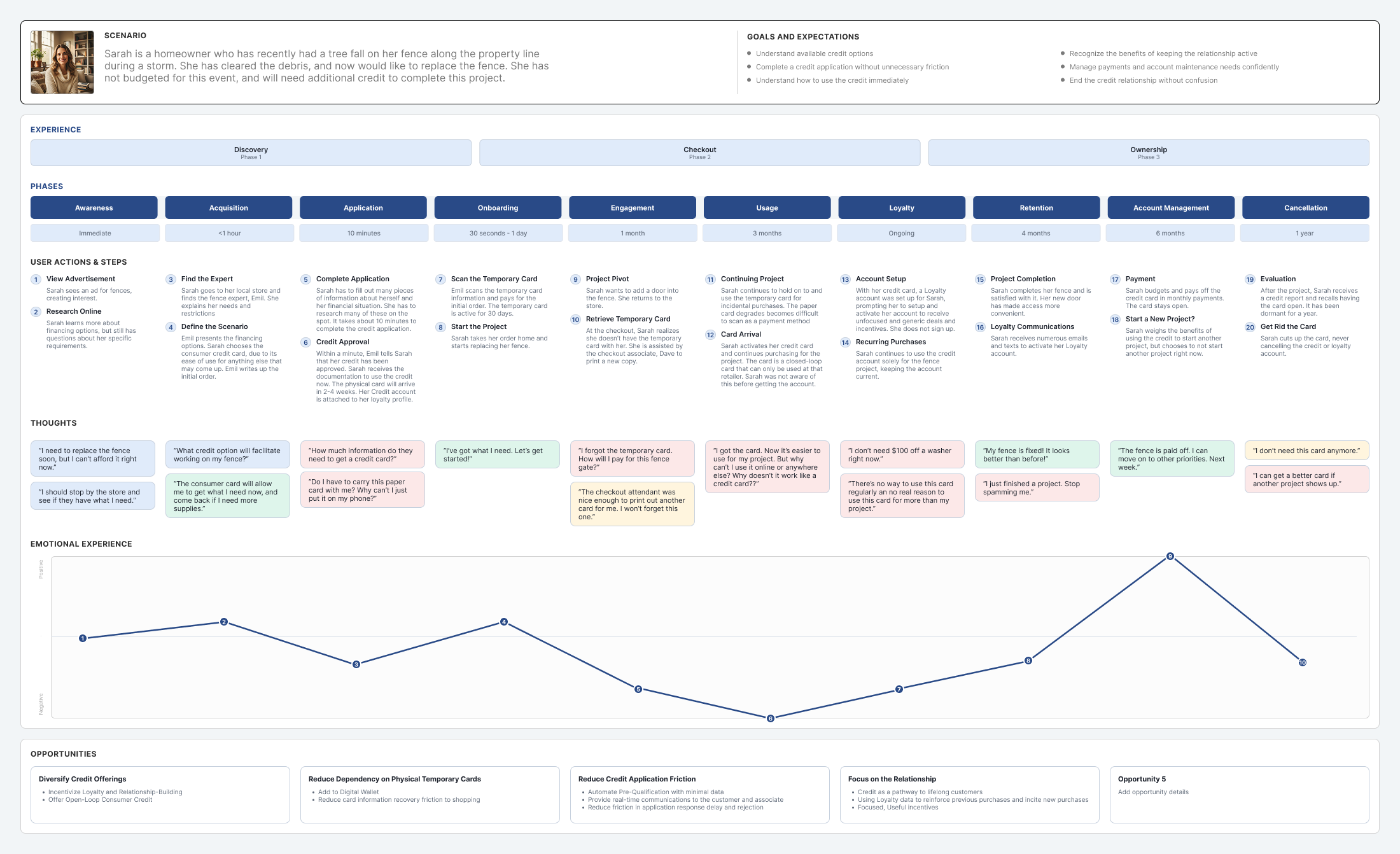
Leadership questioned whether related teams were working toward consistent goals and results. Our Payments UX Principal initiated a credit-experience effort and created a journey map in TheyDo. The group also explored the tool and AI-supported storytelling imagery.
The map became a large, complex starting point for discussion. We captured different information in each conversation and did not reliably reach agreement on next steps. Narrow research topics also left some partners without a clear connection to the work, and participation declined.
How I Structured Shared Direction
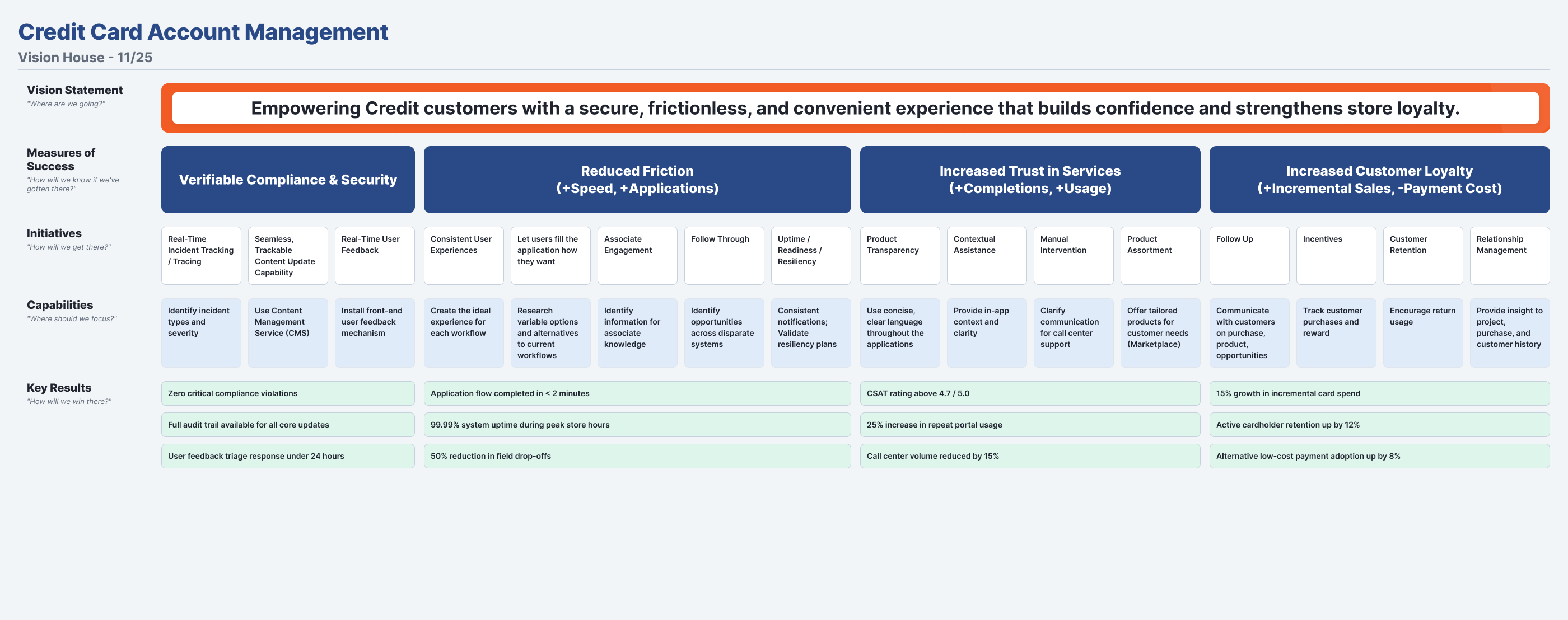
I redirected the conversations toward a Vision House that I built from feedback across online partners, our junior Credit UX designer, business partners, and subject matter experts. Grouping that feedback into larger success areas gave more teams a way to contribute. Initiatives and capabilities described possible routes toward those goals, rather than complete solutions to every problem.
I created a reusable discussion-board template and facilitated one-hour sessions. The original template is unavailable; the prompts I recall covered the problem, the change needed, affected users, technical constraints, and priority. We synthesized each discussion and brought it back to the group to check agreement before handing off decision points.
My strongest area of influence was Reduced Friction, particularly Consistent User Experiences. Consistency meant coherent workflows adapted to different users, devices, and contexts, not identical interfaces across Credit, HR, and Supply Chain. This connected to the AI design sprint, where we consolidated partner feedback into a consistent application workflow using reusable components and patterns.
Explore the AI design sprintFrom Discussion to Implementation
Real-Time User Feedback was an early Vision House conversation that reached a concrete conclusion. I prepared the discussion board, facilitated the session, and handed the agreed decision points to the Credit product management team and Engineering for incorporation into epics and supporting stories. Many of those stories then went through UX designers for implementation, initially supported by Engineering.
The implemented feedback tool was Pendo, which the broader Payments team had recently begun using. The capability collected interface-side information for comparison with back-end information available to Engineering and allowed associates to submit feedback within the live application. This connected user-reported experience with technical information for analysis; measured improvements in issue resolution or satisfaction are not established.
What Changed
I observed broader participation and more discussion of larger opportunities after shifting toward the Vision House. The journey map and Vision House gave partners a shared way to compare customer needs, success measures, and priorities, while the session template made the next planning decisions more explicit.
Based on my firsthand account, Vision House outputs informed Payments planning epics for Q1 2026. The Pendo example provides a concrete link from facilitated discussion to implementation. This does not establish improved delivery consistency or organization-wide adoption.
The key results shown in the Vision House are proposed targets, not achieved outcomes. Online partners contributed to the work, while our team’s own credit delivery remit excluded the online channel.
Evidence note
Based on firsthand recollection and available documentation. Internal materials remain confidential; specific estimates and outcome limitations are noted where relevant.