
Enterprise Transformation · 2021–2022
Point of Sale System Retirement
Summary
A focused effort to map a complex specialty checkout system and align 50+ partners on its retirement plan. Through our team’s analysis and facilitation, most capabilities were assigned to product groups for epic and story creation around shared goals.
My Role and Contributions
Led system mapping and cross-team alignment for specialty checkout retirement planning, drawing on existing product information and team knowledge.
Major Decision
Retain essential capabilities by assigning them to the appropriate product teams, rather than rebuilding them all within one checkout system. Coupon support exposed the limits of that approach when no team initially accepted ownership.
- Led stakeholder sessions and mapped connected workflows and dependencies.
- Worked with the team to group legacy capabilities and clarify product ownership for retirement planning.
At a Glance
Approximate project scope, based on my firsthand recollection.
My involvement in the retirement effort
Stakeholders and partners aligned
Teams represented in system-ownership discussions
Point-of-Sale System Map
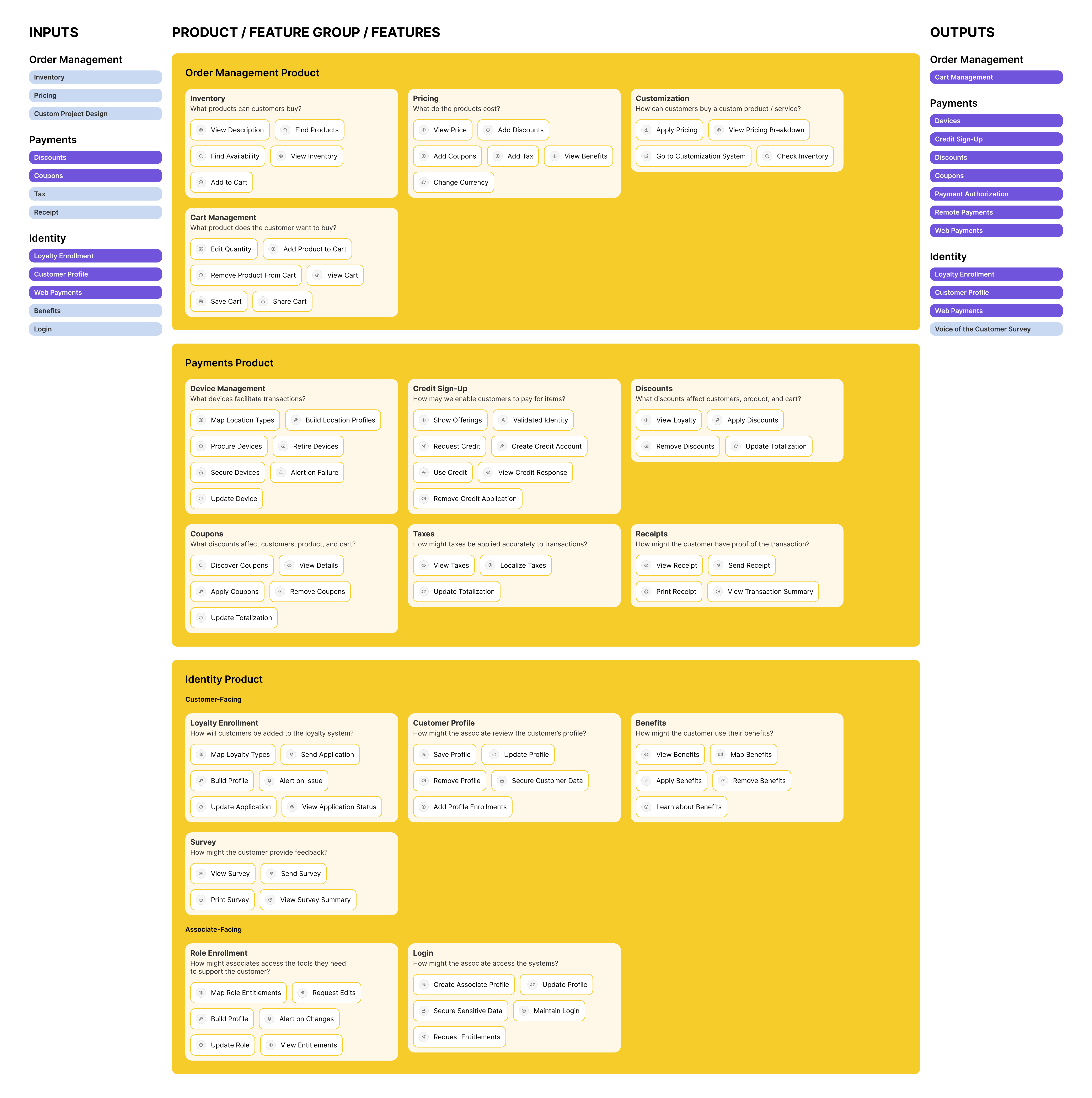
- Internal teams: active participants
- External teams: consulted
- Product grouping
- Feature group; outlined items inside are individual capabilities
The Challenge
The specialty checkout system supported in-store design and large-scale customer projects outside mainline checkout. Over time, it had accumulated capabilities beyond its original scope. Sales and payment workflows crossed 24 systems owned by 16 teams represented in the room, with knowledge and ownership dispersed across those teams. The experience supported approximately ten payment methods and payment channels, including credit, debit, gift cards, and financing, with payment collected at checkout or remotely by phone, email, or text.
Project management and budget decisions established an 18-month replacement window. This was a cross-team retirement project, not a single-product redesign: multiple product teams needed to take responsibility for capabilities previously bundled into the specialty checkout platform. Mainline checkout and online sales were outside our team’s scope.

What We Discovered
Partners initially treated capabilities bundled into the specialty checkout application as that application’s responsibility. Reviewing existing information and discussing features with the team showed how needs crossed product boundaries, challenging the assumption that one replacement application should reproduce the entire legacy platform.
Coupon support involved more than familiar product or percentage discounts: credit, loyalty, and project coupons were essential to the payment experience. Yet ownership fell between Loyalty, Project, Order Management, and Payments. This exposed a mismatch between how teams divided responsibility and how associates needed the system to work.
Similar gaps appeared elsewhere. The Payments group I worked with focused on transaction processing, while responsibility for stored credit card information and purchase history required discussion with teams such as Loyalty and Order Management. Defining those boundaries involved repeated cross-team negotiation, rather than simply assigning each existing screen to a replacement product.
How We Shaped the Replacement
The capability and dependency analysis supported a recommendation to separate capabilities into connected products, including Payments, Order Management, and Loyalty, with interfaces suited to different user groups. Smaller product teams could take responsibility for defined capabilities instead of one project team rebuilding the entire application. The recommended architecture used shared databases and APIs with explicit team ownership to keep information aligned across platforms; this describes the proposed direction, not a verified implementation.
I used product-knowledge sessions, a shared record of metrics and use cases, and cross-team reviews to facilitate ownership discussions. Assigning most capabilities gave product groups a basis for creating epics and stories around shared goals.
I evangelized the need to retain coupon support. The product manager changed the scope of the larger effort to remove it, and the team proceeded without coupons while ownership remained unresolved. Coupon support later returned to the plan and an owning team was identified; I do not know which team accepted it or whether my advocacy contributed to the reversal.
We facilitated ownership discussions with 16 teams responsible for 24 systems connected to the specialty checkout platform. Those capabilities spanned areas such as inventory, pricing, customer information, loyalty, and payments. My retrospective estimate is that we resolved ownership for roughly 80–90% of the platform’s capabilities; this is not a documented feature count or a measure of implementation completion.
Outcome and Reflection
The team produced a replacement direction and a cross-team retirement plan, with responsibilities distributed across products including Payments and Order Management. The estimated $35M+ in annual product sales supported by the specialty experience describes business scope, not attributable savings.
Ownership questions remained unresolved when my phase of the project ended, and system retirement was not complete. Based on my current understanding, the broader retirement effort remains open, with dependencies on legacy architecture, development, and databases. That current status is my firsthand account and has not been independently checked. Security improvements, modular upgrades, and faster transactions are not presented as measured post-launch outcomes.
The coupon decision showed how an unresolved ownership boundary could remove an essential capability from scope even when its importance had been raised. Facilitating agreement across most capabilities was valuable, but the remaining gaps still mattered to a viable retirement plan.
Evidence note
Based on firsthand recollection and available documentation. Internal materials remain confidential; specific estimates and outcome limitations are noted where relevant.
Home Depot fiscal 2021 results — company store and transaction totals